There are surf trips. And then there are those journeys that stay with you long after the last wave. Our adventure surftrip Chile in March 2026 was one of those. Three participants. Surfboards on the roof. A car packed with wetsuits, snacks and curiosity. And a country that doesn’t hold back.
My name is Angie, I had the honour to be the trip organizer and head surfcoach on this epic trip. In a different life I have lived in Chile. I know its rhythms, its people, its moods. And still, every time I return, it surprises me all over again. This trip was different from our usual trips. It was about traveling slowly, surfing consciously, and connecting deeply with a place that has so much to give.
Why Chile for a Surftrip?
If you’ve never considered to surftrip Chile, it’s hard to fully explain until you’re there. The coastline feels endless, the Pacific never really rests, and the waves seem to invite you to stay a little longer on each ride.
Chile has a certain rawness. It doesn’t try to impress you. And somehow, that’s exactly what makes it so impressive. You move through landscapes that shift constantly. Endless beaches, wild cliffs, forests that suddenly feel almost tropical. And in between, waves that give you space not just to surf, but to actually learn. And on top of all that there is a surf culture that’s real, local and refreshingly unpolished. Sometimes Chile doesn’t hand things to you easily. But that’s exactly why it’s so rewarding.
Small Group Travel That Actually Feels Different
This adventure surftrip was intentionally small in participant size. Just Fabus, Ian and Tobi, aka The Boys. No crowds, no pressure, no fixed schedule we had to stick to no matter what.
We started in Santiago and headed north first, exploring the central region of Chile and getting into the rhythm of the Pacific ocean. We surfed a crazy pipeline wave (like next to an actual pipeline) and the wave where surfing in Chile started. So much history in that place. Later, we made our way south, where things became more remote, more powerful and even more beautiful. Wave hunting became part of the rhythm. Some days we scored. Some days we searched. Every day we learned.
Traveling without a fixed itinerary changes the whole experience. You’re not just moving through a country. You’re part of it. You have time to stop when something feels right, to stay longer when the waves are good, or to simply lean back and take it all in.
Surf Coaching: Positioning Changes Everything
The coaching on this surftrip focused on something that often gets overlooked but changes everything: positioning and connection with the ocean. At the same time we had the chance to work on more technical parts as well. The waves in Chile are long. That’s the magic. They give you time. Time to feel what you’re doing, to adjust, to understand.
We spent time breaking down each spot before entering the water. Looking at how the wave breaks, where to position yourself, how to move through the lineup without fighting it. Small details started to make a big difference. Where are your reference points? Where your hands are during take-off. How you shift your weight forward. How your whole body moves, not just your arms or feet.
There were moments during video analysis where things suddenly made sense. And then there were those sessions in the water where it all came together without overthinking.
One of my favorite parts was seeing how everyone started to connect more with the wave. Looking at it during take-off. Moving with it instead of reacting late. That shift changes your surfing in a very real way. Sure, there were challenges, frustration and wipeouts, I am not sugarcoating here. But all these are part of the game and push the end of your comfort zone. And as you can imagine, The Boys rocked it.
Learning From The Locals
A huge part of what made this surftrip Chile special is the connection to local surfers. Our local guides Dani, Morrison and Milton shared not only their knowledge but also their way of approaching the ocean. Each one with their own story and history of surfing. Dani’s father for example was one of the first surfers in Chile. While young gun Morrison is one of Chile’s most stylish surfers, and a well known big wave charger.
Our guides shared their waves with us and also their take on surfing. We learned how to read more than just the surface. How to move around rocks safely, how to understand the flow of a lineup instead of forcing your way into it, how to anticipate conditions before even paddling out.
But beyond that, they made us feel welcome. And that changes everything when you travel. I mean, who doesn’t like to be introduced to other surfers or be invited to a BBQ on the beach?
The Moments You Can’t Plan
This is the part of a surftrip you can’t google. Some of our best experiences of this surftrip Chile had nothing to do with surfing. Here are some examples:
Completos at my friends house. A feria (street market) full of colors and noise. Pisco sours that were bigger, and hit harder, than expected. A “one luca challenge” that turned legendary. BBQs, bonfires, terrace sunsets. Game nights, random movies (hello Homeoffice), inside jokes that will last forever.
We drove through landscapes that didn’t feel real. Stopped in places where the sound of nature simply blew us away. Sat in the hot tup (or in front of the bosca) after long surf days. Watched stars you don’t get to see in Europe.
And somewhere in between all that: we surfed epic waves, shared lineups, and got reminded why we started surfing in the first place.
What Made This Adventure Surftrip Chile So Special
Here is the thing. This trip wasn’t a package holiday or designed to be perfect. It was designed to be real. It was a trip about adapting instead of controlling. Through a country that runs on the concept of ‘ en un rato’ (in a little while). About learning how to surf a place in and out of the water, not just surviving it. About understanding the ocean in a deeper way and taking that knowledge with you wherever you go next.
And yes, we were having a really good time witth new people who, very quickly, didn’t feel like strangers anymore. And fun? Well, there might have been the odd occasion 😉
To Ian, Tobi & Fabus
I am so stoked that you made your way to Chile. Thanks for your trust in letting me show you around this incredible country and it’s waves. I nicknamed you The Boys, and was so proud to see you impress in the water. ‘Es uno de los mios’ (it’s one of my ones) I would proudly say when you ripped just another wave. Epic group, including the creep. By the way, I still think that one luca challenge deserves a trophy.
Want to see what it looked like? We captured some of these moments. Check out the full photo album on our Facebook page.
Surftrip Chile 2027 – Are You Ready For The Next One?
If you’re reading this and something inside you goes “yeah… that sounds like my kind of trip” then let me know. Small group again. Different route. Same idea: real surfing, real travel, real connection.
The next surftrip Chile is now open for bookings. Again it’s only 4 surf spaces so better be quick if you want to be part of the 2027 gang.For info and booking checkhere.
If Chile has been on your mind for a while, maybe this is your sign. I’ll be there. And I’d love to show you the places, the people and the waves that make me fall in love with this country over and over again. .
Sea you there! Love, Angie
PS: missing pics of the epic waves? Well, I believe that not everything needs to be shown online. Better go and look for yourself 😉
As surfcoaches we want our students to improve, and have a great time in the ocean. However, we also have the responsibility for our student´s safety in the water. This his means knowing the local conditions, their skill levels and knowing how to react in case of an emergency.
Being a surfinstructor also means being a lifesaver. When completing the surfinstructor course, general first aid is included, and most licences even request an additional lifesaving course. However, I always felt like this was not enough.
Stepping up from lifesaver to lifeguard
I have been surfcoaching fulltime for 7 years by now. During those years I have seen some pretty nasty accidents, I have rescued an uncountable number of people, I have patched cuts and calmed down panic attacks. Experience is knowledge, and even though I would have preferred not having been part of all those situations, they have also given me confidence to be able to help.
Normal lifesaving licences expire every two years. And it really makes sense to renew the licence regularly, practise scenarios, and get up to date with new procedures. So when my surfcoach lifesaving licence expired I found myself wondering: am I really prepared to save someone´s life? Would I know how to react correctly in a more serious situation?
The decision to become a lifeguard
Being honest with myself, I could not answer these questions with a 100% convincing yes. This led to my decision to step up my game and sign up for a proper lifeguarding course. Yeees, the whole Baywatch type of thing, can you imagine? As travelling is a bit tricky at the moment I checked on the other nearby islands and luckily found Paul from Lanzarote Lifeguarding und Lawaflow Surfschool.
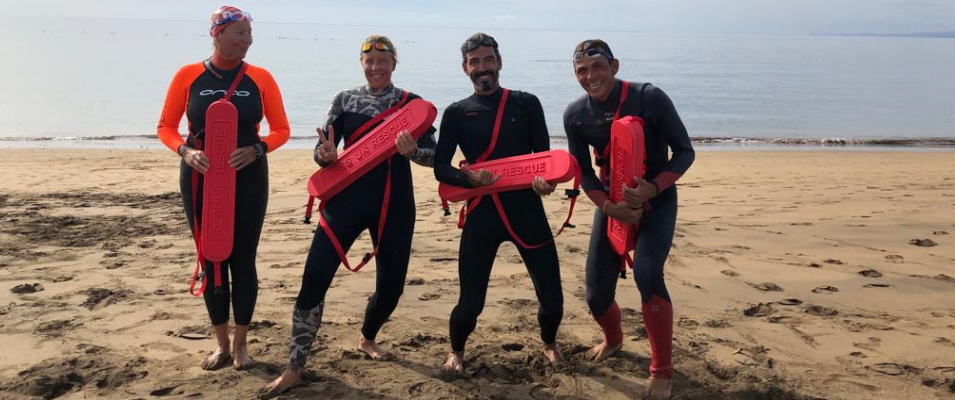
After a few uncessful attempts of me hopping over to Lanzarote, I finally managed to sign up for the RSLL Vocational beach lifeguard course in October. Little did I know that I was signing up for a swimming course as well. Turns out that Paul also runs the Swim Lanzarote school, training eager people for triathlons and even the Iron Man competition. This is me during the beach practice.
Swimming, running, rescue techniques and loads of knowledge
So here I was, ready to improve my skills and my expertise. In order to pass the course I had to pass a swim test: 400m swim in the open ocean in less than 8 minutes. That scared the hell out of me. I am a very trained paddler but I couldn´t really remember the last time I swam 400m. Paul and Phil, the other course presenter, eased my doubts right from the beginning, ensuring me that I would be able to pass the test by the end of the week. Cheered on by their hopes I simply started swimming, and imagine how surprised I was when I passed the test straight away.
The week was saved. Or so I thought. What I totally underestimated was the amount of information my brain had to process, and remember. I felt really stupid having thought before that I knew anything about lifeguarding. The truth is that I was lacking skills and confidence in several areas.
But Paul and Phil reinsured me that I was doing great, and finally I stopped doubting myself. We swam, we ran on the beach, we practiced rescue techniques – repeating thing over and over again. After each morning on the beach I was physically and mentally exhausted. But after a short lunch break I felt ready to take on the afternoon theory sessions.
Repetitions are the key to a quick reaction
After all the practice in the water and on the beach it was now time to learn. Soon my brain was filled with accident scenarios, ocean theory, regulations, communication methods and different CPR procedures.
Cardiopulmonary resuscitation (CPR) is an emergency procedure that combines chest compressions often with artificial ventilation in an effort to manually preserve intact brain function until further measures are taken to restore spontaneous blood circulation and breathing in a person who is in cardiac arrest. (Wikipedia)
We practiced CPR in various scenarios: an unconscious adult, a suspected drowned adult, a child and an infant. CPR consists of chest compressions and breath, in a 30:2 ratio. However, if you are dealing with a child, infant or suspected drowning casulty you start off with 5 breaths first, then 30 compressions, then back to 2 breaths, 30 compressions, 2 breaths and so on.
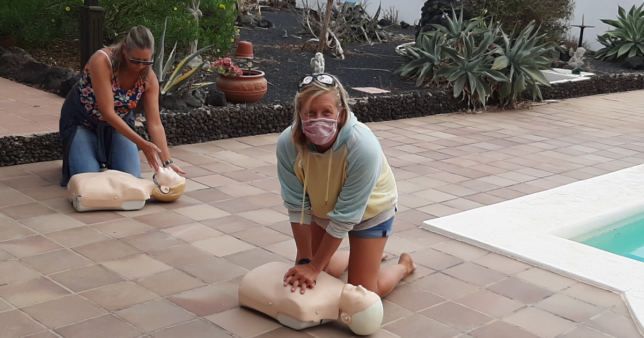
I have learned CPR before (and I really hope that I never have to use it) but only now, after 5 intense days of repeated practice, I sort of feel confident enough to say that I could react quickly in a serious situation.
Being a qualified lifeguard makes me a better surfcoach
I am thrilled to say that in the end I passed the course, and am now a RLSS qualified vocational beach lifeguard. I have passed the swim test, the fitness test required to validate my licence here in Spain, the rescue techniques test, a written test and an interview test. And my brain is still buzzing with all the new things I have learned.
I love my job as a surfcoach, and assume the responsibility that comes with it. Being a trained lifeguard makes me feel more confident, knowing how to react in emergency situations, assuring the safety of my students, and even the other surfers around me.
I can only call on other surfers to get motivated and also train to become a lifeguard. This way we can create a safe surfing environment, in times when our beloved sport has turned into something like a mass movement 😉 Why not combine your next holiday with a lifesaver course? I can highly recommend Paul & Phil, great humans, highly professional and always good for a laugh.
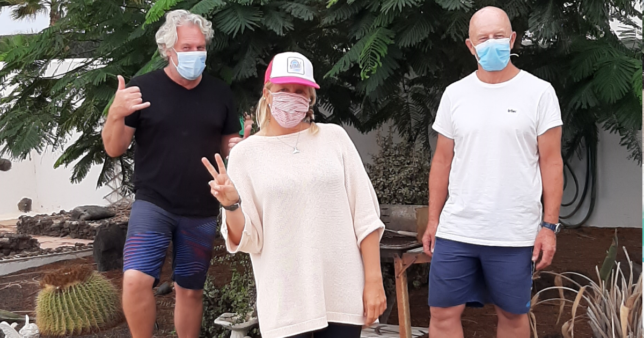
Thanks guys for a real fun week, all your support and everything you tought me. Catch you soon for some waves and cool projects together.
So that´s it, that´s what it feels like. Being landlocked. Not being able to surf on a daily basis. The unfortunate reality for a lot of surfers who don´t live close to the beach. A completely new experience for those of us who are lucky enough to have an ocean near by. The global corona virus crisis has ´landlocked´ a lot of surfers on this planet.
Dont´get me wrong, I am not complaining. How could I? From the roof of my house in Fuerteventura I can still the see the ocean in the distance. But seeing the ocean and feeling the ocean, that´s two different pairs of shoes. Even though I am convinced that our absence will only benefit the health and balance of our oeceans, and even though, after 48 agonizing days, we are now allowed back in the ocean, I am still trying to come to terms with this short journey of being landlocked.
Living a surfer´s life – how it all started
The decision to live close to the ocean came naturallly. 12 years ago to be precise. I can´t even remember having made a decision at all. It wasn´t that at some point I decided to live in front of a wave, it was just that I couldn´t imagine not doing it. It just felt totally right and comfortable. This beautiful beach I lived at in Chile just gave me everything I wanted: the freedom to surf every day, at any given time. The freedom to live my life without having to wear shoes and making bonfires every night. The freedom to just be me.
Returning to Europe was a very personal decision. But never would it have crossed my mind to settle down somewhere away from the ocean. And that´s the funny thing. At not one point did I now even consider living landlocked. Why would I? The ocean provides me with everything I need and want. So to me it just made sense to go and live on an island in the middle of the Atlantic Ocean.
What happened next
So here I was, happily living on Fuerteventura. The small town I live in has no coastline, it´s right in the middle of the island, in between the North-, West- and Eastcoasts. So why would I want to live here instead of having the ocean in front of my window? Well, often you can´t really choose who you fall in love with, right? And I simply fell in love with the charm of Lajares, it´s vibes and people.
Also here on Fuerte, the wind can be a big issue. So having the choice of having all three coasts in short distance makes it a lot easier to decide in the morning where to go for a surf. Here we always depend on the swell and wind directions.
Back to me living and surfing without much worry. And once in a sudden, the world gets put on standbye. And the Spanisch government tells me that I have to stay inside my house. Sure, we were allowed to do the odd supermarket / pharamacy run but the ocean was totally off limits. And there I was. Being landlocked. I guess the term landlocked might not fit a 100% it because I live on an island. But the feeling must be pretty much the same: this subliminal feeling of not being able to access the ocean.
And that´s what being landlocked felt like
To be honest, it felt like a punch in the head and totally threw me off balance. I don´t know how the ocean does it but by now it is part of my personal existence. The ocean gives me balance when I am dangling off the ceiling. The ocean puts things (and myself) back into perspective every time. The ocean absorbs my emotions and turns them into pure joy. The ocean provides me with a sense of peace that´s hard to find anywhere else.
Surfing is a sport that get´s into your veins. It connects you with mother nature and with yourself. It teaches you to reset your body and mind, and it shows you how to flow. Even outside the water.
Having the privilage of living a surfer´s life temporarily taken away from me was something I have never even thought about before. And was something I wasn´t prepared for at all. Despite struggling to understand what is happening in the world and where we all went wrong, once in a sudden I had to find out how to channel my emotions outside the ocean. Who doesn`t know the feeling of going for a surf with the head filled with pain, anger or frustration – just to return from the ocean all reset and full of positive energy.
What I have learned
Having lived without being able to surf tought me a lot of lessons. It made me realize how much I depend on the ocean and how important surfing it is for me. It is my job, which I love, but it is also so much more than that!
I guess, appreciation is one of the biggest lessons I have learned. To appreciate how lucky I am to live my life this way, and how much for granted I have taken it.
Gratitude for being able to share the moments in the water with other surfers would be another lecture I have been tought. I mean, how amazing does it feel to surf a nice wave and have someone cheering for you from the channel. Now that we have returned to the ocean I have noticed how the atmosphere in the water has changed. While before a lot of surfers, and that´s me included, would have been concentrated on catching as many great waves as possible, now waves are being let passed by, cheers of ´dale, dale´ (´go, go´) can be heard and smiles are present everywhere.
I feel like I have returned to the essence of surfing. Being a sport with a commercial site (which I am a part of) has made me somehow forget what surfing is all about. It´s about sharing moments, laughters and good vibes. So here I am now, having finished this unwanted ocean free time, and strangely I feel more connected to the ocean than ever before!
Thanks for joining me on my journey! Stay safe & healthy!
This website uses cookies to improve your experience. We'll assume you're ok with this, but you can opt-out if you wish. Cookie settingsAccept
Privacy & Cookies Policy
Überblick: Datenschutz
This website uses cookies to improve your experience while you navigate through the website. Out of these cookies, the cookies that are categorized as necessary are stored on your browser as they are essential for the working of basic functionalities of the website. We also use third-party cookies that help us analyze and understand how you use this website. These cookies will be stored in your browser only with your consent. You also have the option to opt-out of these cookies. But opting out of some of these cookies may have an effect on your browsing experience.
Notwendige Cookies sind für das einwandfreie Funktionieren der Website absolut notwendig. Diese Kategorie umfasst nur Cookies, die grundlegende Funktionalitäten und Sicherheitsmerkmale der Website gewährleisten. Diese Cookies speichern keine persönlichen Informationen.
Any cookies that may not be particularly necessary for the website to function and is used specifically to collect user personal data via analytics, ads, other embedded contents are termed as non-necessary cookies. It is mandatory to procure user consent prior to running these cookies on your website.